Why Most Sports Bettors Lose Money
Sports betting in Canada has become more accessible than ever before. In Ontario especially, the launch of the regulated iGaming market transformed online betting from a niche hobby into a mainstream entertainment industry. Modern sportsbooks now compete aggressively through:
- mobile betting apps,
- live wagering systems,
- same-game parlays,
- personalised promotions,
- and real-time betting notifications.
For many new bettors, the process looks deceptively simple.
Watch the games.
Follow sports news.
Trust your instincts.
Place bets.
Win consistently.
That perception is exactly why so many people underestimate how difficult long-term sports betting actually is.
Because despite the rapid growth of online sportsbooks across Ontario and the rest of Canada, one reality rarely changes:
Most sports bettors eventually lose money over time.
Not because they are unintelligent.
Not because sportsbooks are secretly manipulating results.
And not because sports outcomes are impossible to predict.
The real reasons are usually much more ordinary:
- emotional decision-making,
- poor bankroll discipline,
- misunderstanding probability,
- unrealistic expectations,
- and psychological pressure during losing streaks.
Once bettors understand where losses actually come from, sports betting starts looking less like easy money — and far more like a long-term exercise in emotional control and risk management.
The Biggest Myth in Sports Betting
One of the most common beginner mistakes is believing that strong sports knowledge automatically creates betting profit.
It doesn’t.
A bettor may understand:
- NHL line combinations,
- NBA matchups,
- UFC fighting styles,
- NFL injuries,
- or soccer tactics extremely well…
…and still lose consistently.
Why?
Because sports knowledge and betting profitability are not the same thing.
Sports betting is not simply about predicting winners.
It is about understanding:
- probability,
- pricing,
- variance,
- expected value,
- and risk exposure.
That distinction matters enormously.
A Toronto Maple Leafs fan may correctly believe the Leafs are likely to win a game. But if the sportsbook odds already fully reflect that probability — or slightly exaggerate it due to public demand — the wager may still offer poor long-term value.
This is where many recreational bettors quietly lose money without fully understanding why.
Sportsbooks Begin With a Mathematical Edge
Every regulated sportsbook in Ontario builds margin directly into the odds.
This is commonly called:
- bookmaker margin,
- vig,
- juice,
- or overround.
Even relatively small sportsbook margins create a powerful long-term advantage over thousands of wagers.
That means bettors are never competing against luck alone.
They are also competing against:
- sophisticated pricing systems,
- efficient betting markets,
- public betting behaviour,
- and psychological bias.
Sportsbooks do not need every bettor to lose immediately.
They simply rely on mathematics working consistently over time.
And in most cases, they do.
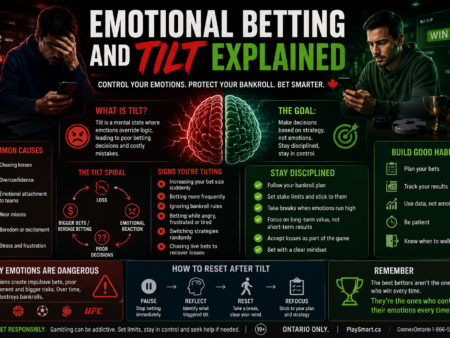
Emotional Betting Quietly Destroys Bankrolls
Most long-term betting losses are not caused by lack of sports knowledge.
They are caused by emotional reactions.
This happens constantly in online sports betting:
- increasing stake sizes after losses,
- placing impulsive live bets,
- chasing quick recoveries,
- betting emotionally on favourite teams,
- or abandoning bankroll rules after frustration.
Emotion changes betting behaviour faster than most players realise.
A bettor who normally behaves rationally may suddenly:
- double stake size,
- add risky parlays,
- or continue betting late into the night after a bad session.
At that point, betting stops being structured.
It becomes reactive.
And reactive betting is usually expensive.
Chasing Losses Is Where Most Damage Begins
One of the most dangerous moments in sports betting happens immediately after a losing streak.
The brain naturally wants to recover quickly.
That pressure creates thoughts such as:
- “I just need one good win.”
- “One parlay gets me back.”
- “I’ll reduce stakes after I recover.”
This behaviour is known as chasing losses.
And it is one of the fastest ways to destroy a betting bankroll.
Why?
Because chasing losses usually creates:
- larger stake sizes,
- lower-quality decisions,
- riskier selections,
- and emotional betting patterns.
Ironically, the attempt to recover losses quickly often produces even bigger losses.
This cycle is extremely common in both sports betting and online casino gambling.
Why Parlays and Same-Game Parlays Are So Popular
Ontario sportsbooks heavily promote:
- parlays,
- same-game parlays,
- bet builders,
- and multi-leg accumulators.
Why?
Because they are emotionally attractive.
Small stake.
Huge payout potential.
Massive excitement.
But mathematically, every additional selection dramatically increases overall risk.
Many bettors underestimate how aggressively probability compounds against them inside large accumulators.
A five-leg parlay may emotionally feel “close,” but statistically it remains extremely difficult to hit consistently.
This is one reason sportsbooks market these products so heavily:
- they increase engagement,
- encourage higher betting volume,
- and strengthen long-term sportsbook margin.
That does not make parlays scams.
But it does mean they are often far worse value than players realise.
Live Betting Creates Faster Emotional Decisions
Modern sportsbook apps are designed around instant engagement.
Players now have access to:
- live odds,
- in-play props,
- instant cash out features,
- rapid market updates,
- and constant betting opportunities during games.
This creates excitement — but also pressure.
Live betting reduces the time available for rational analysis.
Many bettors place in-play wagers based on:
- momentum swings,
- frustration,
- excitement,
- or emotional reactions to previous bets.
The faster the betting environment becomes, the easier it becomes for discipline to disappear.
This is why live betting often feels much easier than it actually is.
Most Bettors Dramatically Overestimate Their Edge
Human psychology naturally remembers:
- wins,
- near misses,
- and emotionally satisfying results more vividly than ordinary losses.
This creates overconfidence bias.
A bettor may win several NHL bets in a row and begin believing:
- they understand the market better than sportsbooks,
- they have superior prediction ability,
- or they are consistently profitable.
Sometimes they are simply experiencing positive variance.
Short-term success does not automatically prove long-term skill.
And this misunderstanding quietly traps many players into:
- increasing stakes too quickly,
- overbetting,
- or abandoning disciplined bankroll management.
Betting on Favourite Teams Is Usually Bad Long-Term Value
Canadian bettors frequently wager emotionally on:
- NHL teams,
- hometown clubs,
- national teams,
- or heavily supported favourites.
Sportsbooks already understand this behaviour.
Public betting demand strongly influences odds pricing.
Popular teams often become slightly overpriced because sportsbooks know recreational bettors are emotionally attracted to them.
This reduces long-term value.
Many experienced bettors intentionally avoid betting on teams they emotionally support because bias becomes much harder to control.
Modern Betting Content Creates Unrealistic Expectations
Online betting culture is heavily driven by:
- massive winning screenshots,
- “VIP picks,”
- guaranteed betting systems,
- influencer gambling content,
- and viral parlay wins.
What rarely gets shown:
- long-term losses,
- variance,
- bankroll collapse,
- emotional pressure during downswings,
- or failed betting systems.
This creates the illusion that profitable sports betting is relatively easy.
In reality, long-term betting success usually requires:
- discipline,
- patience,
- emotional control,
- risk management,
- and realistic expectations far more than “hot picks.”
Ontario’s Responsible Gambling Framework Exists for a Reason
Ontario’s regulated sportsbook market includes mandatory responsible gambling systems because emotional betting losses can escalate quickly.
Licensed sportsbooks now provide:
- deposit limits,
- cooling-off periods,
- session reminders,
- self-exclusion systems,
- and betting history tracking tools.
These systems are not designed to remove enjoyment from sports betting.
They exist because regulators and gambling researchers understand something important:
Human decision-making becomes unstable under emotional financial pressure.
And modern sportsbook apps are specifically designed to maximise engagement and continuous interaction.
That combination can become dangerous without proper limits.
Disciplined Bettors Usually Look Boring
Bettors who survive long term usually focus less on excitement and more on structure.
They tend to prioritise:
- bankroll management,
- percentage-based staking,
- selective betting,
- emotional control,
- and realistic expectations.
They also avoid:
- oversized parlays,
- emotional live betting,
- impulsive recovery bets,
- and dramatic stake increases after wins or losses.
Most importantly, they understand that losing streaks are normal.
That mindset alone separates disciplined bettors from emotional ones.
Sports betting becomes much more dangerous the moment a player starts expecting:
- guaranteed profit,
- financial recovery,
- or easy long-term income.
Because once betting becomes emotionally tied to money pressure, discipline usually starts collapsing very quickly.
And when discipline disappears, bankroll destruction often follows not long afterwards.